
The Boundary Boost
Practical advice, insightful strategies, and real-life examples to help you create a balanced and fulfilling life through healthy boundary setting.
Subscribe now to get your weekly boost — direct to your inbox!
The Cost of Overgiving
When's the last time you looked at your week and thought: How did all of this become mine?
If you've ever had that moment, you already know — it doesn't usually happen all at once. It creeps in quietly, one small thing at a time.
Overgiving doesn't usually start with generosity.
It starts with something much quieter: I'll just handle it.
You're capable. You see what needs to be done. So you do it — not because someone asked, not because it officially belongs to you, but because you care about the outcome and you're good at getting things started.
That's actually one of your greatest strengths.
But here's what I want you to sit with: what happens when that strength starts running on autopilot?
The Whiteboard That Said Everything
I had a moment recently that stopped me in my tracks.
I went to throw a load of laundry in and immediately hit a wall. My daughter's clothes were still sitting in the washing machine from the day before. I pivoted to the dryer — my son's clothes, also from the day before, still there.
Not a crisis. Mildly annoying. But it was Tuesday.
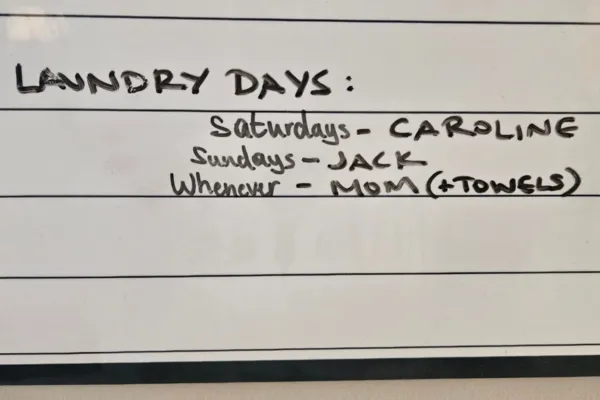
In our house, my daughter's laundry day is Saturday. My son's is Sunday. So somehow, two days into the week, both systems had already unraveled. I walked over to our command center whiteboard to double-check.
Saturday — Caroline. Sunday — Jack.
And next to my name?
"Whenever."
I actually laughed.
Not because it was funny, exactly — but because of how perfectly that one word summed up so much. There was no day for me because my responsibilities were the ones that floated. The ones that expanded and contracted. The ones that got squeezed in around everything else.
No one decided that. No one sat down and declared that my time was the most flexible. It just... happened.
And that's the thing about overgiving — it almost never announces itself. It accumulates.
How It Quietly Becomes Yours
There's rarely a dramatic moment where someone hands you more than your share.
No meeting. No formal conversation. No one says, this is yours now.
Instead, it happens in small, ordinary moments. You take something on once, just to help. Then again. And because you do it well — and because you care — it sticks. At work, you become the one who always follows up. At home, you're the one holding all the details. In your relationships, you're the one making sure nothing falls through.
Before long, there's an entire invisible infrastructure running inside your head. Appointments. Follow-ups. Things that need to happen. Things that almost slipped. Things only you seem to remember.
And nobody assigned that to you. You just... became it.
The more capable you are, the more this happens. You notice what needs attention — so you give it attention. And over time, that attentiveness starts to look, from the outside, like availability. Like capacity. Like she can handle it.
This is what I often call the Competence Trap: the quiet pattern where responsibility grows until your time and energy no longer really belong to you.
The Hidden Weight
Here's what makes overgiving so hard to see: it doesn't always look like a problem.
Your days might look completely manageable. You're organized. Things are getting done. On paper, you're fine.
But there's a weight that lives underneath the doing.
It's not just in the tasks themselves — it's in the ownership of them. The mental load of tracking everything. The anticipating. The remembering. The constant low-level awareness that something will slip if you stop paying attention.
That weight doesn't show up on a to-do list. But it shows up in how you feel at the end of a day when, by every reasonable measure, nothing went wrong.
And here's the part that catches a lot of women off guard: the very reason you're carrying so much is the same reason it's hard to set any of it down. You care. You care about doing things well. You care about the people around you. You care about things not falling apart.
So rather than questioning what you've taken on, you just keep adjusting yourself to hold it.
The Emotional Layer Underneath
Let's be honest about something: the hardest part of overgiving isn't usually the workload.
There's an emotional layer underneath it that's worth naming.
When you care deeply, "saying no" doesn't feel like a simple logistical decision. It can feel like a threat to who you are — to the reliable, capable, there-when-it-matters version of yourself you've built your identity around.
So you keep saying yes. Keep stepping in. Keep absorbing.
Until something starts to shift.
Maybe it's fatigue. Maybe it's a low-grade resentment you can't quite explain. Maybe it's the quiet feeling that something in your life is running on fumes — and that "something" is you.
That shift, uncomfortable as it is, is actually worth paying attention to. A sign that the current arrangement has become unsustainable. And recognizing that? That's an important distinction to make.
The Question Worth Sitting With
One of the most powerful realizations women have when they start looking at this pattern is also one of the simplest:
Not everything I'm carrying is actually mine to keep.
That realization doesn't make you less generous. Your care doesn't shrink. What changes is how deliberate you become about where it goes — and whether the things claiming your time are things you've actually chosen, or things that just quietly accumulated until they felt permanent.
Overgiving thrives in autopilot. It starts to shift the moment you step out of it.
So here's the question I'll leave you with:
What's something you handle in your life right now that wasn't originally your responsibility?
Just notice what comes up.
Because that "whenever" on the whiteboard doesn't just show up in household chores. It shows up in how we unconsciously treat our own time — as the thing that bends around everything else.
And awareness is exactly where this pattern begins to change.

Copyright 2025 | Steph Koenig Coaching | Terms & Conditions